|
The Shtutsin (Szczuczyn) Holocaust, Part A |
|
|
|
How the Jews of Shtutsin (Szczuczyn) Struggled and Suffered, By: Chaye Soika-Golding
The following letter, written in Holland in July of 1945, describes in detail how
the Germans tortured the Jews of Shtutsin (Szczuczyn) and destroyed the entire
community. The author of this letter, Chaye Soika-Golding, survived through all
the horrors of the German occupation so her accounts are therefore an authentic
testimony.
|
Almelo, Holland, 22/7/1945
Dear Yeshiah Skubelski!
I was overjoyed with your letter. I understand your wish and am answering you
immediately, even though telling how the extermination of he Jews came about is
not a pleasant mission.
|
|
 |
|
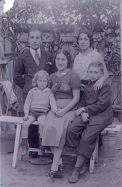
Golding Family,
mid 1930's
Back: Isaac Golding
Dora (nee Golding) Kahn; Front: Chaya and her daughter Shulamiske,
and Dora's son |
|
| |
|
In the very first days of the war in 1939, a chain of calamities had begun to
unfold in Szczuczyn. That Sabbath morning all men were required to register. Not
knowing what was happening, everyone presented themselves at the marketplace.
The Germans registered 300 men and then forced them to the synagogue in the new
section. Your brother Boruch Leyzer was amongst them, as well as my brother Isak,
my brother-in-law Lipe Chaim, Rozental Zalmen, your cousin Galant and many many
others. They were held at the synagogue for one day and on the second day they
were brought to Prostken [Prostki, 10.4 miles NNE of Szczuczyn, just to the west
of the Prussian/Russian border]; from there further into the heart of Germany.
You can imagine what an impact this action had on the remaining families A few weeks
later I arrived from Ostrolenke (Ostroleka), where the Jews had also been driven
out. The shock was already familiar to us. it was believed that any day the men
would return. We collected money, we looked for people with influence, we wrote
pleas on their behalf. We made fools of ourselves but all our efforts were like
a stone in water. One day we received two cards from the men; there was no news
after that. The difficult winter of 1940 fell upon us -- incredible freezing
temperatures, just above minus 40 C. There was talk that the Bolsheviks had
brought the frost from Siberia. In this horrible freeze they [the Germans] had
unexpectedly freed the above mentioned from the camps. The men traveled 5 days
on the train. The bread they were rationed was eaten up immediately on the first
day. It was a difficult journey. They were not given a single drink of water.
They licked the panes from thirst. It was crowded and hot in the wagon. My
brother Isak died on the way home. There were many deaths during the trip. And
those who survived, what happened to them? It is a horror story for me to
recount.
When the men stepped out of the train the Germans opened fire on them. Turmoil, panic
and flight broke out. The majority ran from the scene. Lipe Chaim, together with
a large group, escaped and crossed the Russian border near Brisk
(Brest-Litovsk). Many of them with frostbitten limbs were taken to hospital
there by the Bolsheviks. When they recovered they were sent into Russia, to
Archangel. Others, including Boruch and Lavi Sheynberg who later married, went
to the shtetl Vlodave (Bledowo) on the German side. Still others struggled
through and managed to return to Szczuczyn.
Of the 300 taken, maybe 30 came back. My brother-in-law Lipe Chaim found himself
near Brisk (Brest-Litovsk) and wanted to cross into the Soviet Union to be
together with his wife and child. Along with others from Shtutsin (Szczuczyn) he
tried to swim across the Bug River at night. He did not succeed. The border
guards did not let them pass -- "spies" was their answer. They tried
again the second night. The frost was terrible. Summer coats, tight shoes, deep
snow, it was impossible to go any further. With each passing moment limbs grew
weaker. Lipe Chaim remained sitting on the frozen river, remained sitting
forever. He said vide [12], asked his
companions to greet Dora on his behalf, and then froze. The details were told to
us immediately following the catastrophe. We left with smugglers to search for
the corpse but did not find it.
I do not know what happened to your brother. Your cousin died in Brisk
(Brest-Litovsk). Your parents also did not know the kind of death their son had
met. Some of those who came back: Koyfman Segalovitch's nephew from the iron
works; Kalman Shifrak (now residing in Israel); Binyomin Sosnovski a shoemaker;
a great determined young man Zeydke Koshtsiol, the driver, and other strong
ones. They told us of their life in the camps. Boruch Leyzer beared up all right
unlike Lipe Chaim. Your sister-in-law with the girls left to join their family
in Augustow.
These events affected our parents greatly. Your father as well as mine grew silent,
gray and weak. The beautiful synagogue and Bes Hamedresh were burned
down. Everyone prayed in the new section, in the House of Study. Shabbos
and High Holidays your sister would anxiously await your father, and we sisters
-- our father. We would meet and wait together. Their steps were slow as with
all old folk, and Yehoshue Aryeh, your uncle the Dayan [13]
akh! What and old man already, he could hardly make it to the house! So that he
shouldn't have to go three times a day to the synagogue -- which was too
difficult for him -- he practically would live at the House of Study. Out at
dawn, the children would bring him back at night. Repressing the grief, after
his lost Isak and such a nephew as Lipe Chaim, my father died in his own bed in
February, 1941. Two months later your uncle the Dayan, Reb
Yehoshue Aryeh, died. Both passed away as Tsadikim. Both my mother and
myself had at least the honor to have talked with him a few days before his
death. We had gone to visit him. He had been very close to my mother.
On June 22, 1941, the Russo-German war broke out. The Germans entered Shtutsin
(Szczuczyn) with lightning speed. They hung up their swastika flag and pushed on
further. The city lay in chaos. Authority passed to the hands of the Poles. This
lasted about two weeks. All kinds of rowdies were let out of prison: Dombrovski
Yakubtshuk, the well known Polish arrestees under the Bosheviks -- Shviatlovski,
chief of the guard and Yankayitis, the director of the school, and others. They
were full of rancor for the Bolsheviks and the Jews. Friday night when the
entire city slept quietly, the slaughter began. They had organized it very well:
one gang in the new section, a second in the marketplace, a third on Lomzher
Street and a fourth on the Pavelkes. There in the new section they murdered
Romorovske's family (the tailor), Ester Kriger (your neighbor with the youngest
daughter), Soreh Beylkeh, Eynikl, Pishke, Yashinski, Mayzler (the head of the
yeshivah) -- all in their own houses. Your family saved themselves; on hearing
the screams from Ester's house they ran off to the fields. Dan Kaplan the
photographer, and Rive's man Tsirlak with child and mother, escaped through the
window and ran to the "Vales." At dawn they came to me.
I had been living in Dore's apartment in Reb Yosele's house. The murderers did not
come there. They had killed Rozental's children in the marketplace. They had
also killed Kheytshe with her six month old child at breast and her older boy
Grishen, Beyle Rochel Guzovski with her children, Bergshteyn, Slutske's family,
Tevye Sheynberg's children and many more.
On the Pavelkes the mobs murdered Gabriel Farbarovitch with his family and the
Bergshteyns. Leyzer Sosnovski was led to the slaughter house and there was told
to put his head on the stump; with the machine with which animals are
slaughtered they, killed him. My hair stands on end from the grimness of it all.
Later the squads divided up the possessions of their victims amongst themselves.
On readied wagons they loaded the corpses and led them just outside the town.
The goys immediately washed the bloodied floors including the stones on the
street. A few hundred sacrifices had taken place in one night and still, the
murderers informed us, the massacres would continue for two more nights.
Those remaining were stricken with fear. What do we do? How can we save ourselves? My
mother ran to the priest to beg for the Jews. They offered no help. With Chane
Libe Zeml and Salen, I ran to the Polish intelligentsia. There too we found no
salvation. My mother with two other women ran after help in Grayeve (Grajewo),
they were not let into the town -- curfew. What do we do? Night was falling
upon. us. Approximately 20 Germans entered the city -- a field troop. We were
afraid to show ourselves before them Then I had an idea: to try our luck with
the soldiers, maybe they would help us. With great difficulty we chose a
delegation and departed. The group of Germans consisted of soldiers and two
officers. In the beginning they declined to help us, "This is not our business,
we are fighting only on the front, not with civilians," they explained. However,
when I offered them soap and coffee, they softened up. They guarded the city at
night and all remained quiet. I with two other women began to work for them, and
later we were placed to work in the German headquarters.
And so, in this manner, the pogroms in Shtutsin (Szczuczyn) were stopped for
awhile.
At the same time similar events were taking place in Grayeve (Grajewo), Vanses
(Wasosz), Radzilove (Radzilow) and so on. In Radzilove (Radzilow) all the Jews
had been driven into the largest barn which was then lit aflame from all sides.
Polish school-children wanted to rescue their Jewish girlfriends from the
burning building, but the girls repudiated them and ran back into the flames.
The Poles did all this. Such ghastly scenes took place in other shtetlach.
Shlafak, Shtabinski in Radzilove (Radzilow), Matis Keyman with his wife and
children in Vanses (Wasosz) -- they all had an ugly death.
In our city we were forced to go everyday to the market and tear away the grass
from between the stones. Every household had to supply two or three persons.
Monday evening (I think it was the 24th of July) instead of leaving the
exhausted Jews to rest in their homes, tired from work and sun, they hastened
everyone to the new section. A mob of urchins appeared -- children, who pursued
them with sticks. People were rounded up from their homes as well. All were
forced in one direction. From the new section they were led further to the
cemetery (I was not amongst them). It was understood what would take place. One
hundred men were chosen; they remained there. The women, children and elderly
were sent back home. These 100 men were one by one in the most bestial manner,
with axes, sticks and shovels, murdered. Amongst them were Salmon Leyzerzon with
his son Meyir, Yeshiah Kokoshka, Lifshteyn, Panush and many more.
Shtutsin (Szczuczyn) stood black in ruin, her Jewish inhabitants sad and desperate. The
synagogue and the old House of Study had already been destroyed by the Germans
in 1939, and now even the new House of Study was ruined. The entire area
beginning from Pinchas Rozen's house as far as Penzuch's house, had been burned
out by bombs. The Vansaser Street as well was partly destroyed.
This was the second act In our shtetl. All this was effected by the Poles. In the
month of August, a Thursday evening, Merutshkovski the "parson" of City Hall,
rung the bell and informed the Jews that the following day they should assemble
in the square. A fresh panic arose. That night no one slept. Friday morning,
8:00 a.m., everyone gathered. Men, women and children, and young girls, were
placed apart from each other. Officiating were two Gestapo men and some SS
guards. The Polish police were very busy running all over, searching through the
houses to make sure no one had hid themselves.
In the marketplace they beat the Rabbi Efron, Z.TS.L., and all those whom they had
found hiding. The men and young girls were led to Krumer Street. They walked
five in a row like soldiers. At the courtyard of Biblovits the guards stopped to
shove the elderly men into the grainhouse. Your father was one of them, as well
as Yeshiah the rabbi, the ritual slaughterers -- Radziminski, Goldfarb and
Tutlman -- and many others. In the storehouse they gathered the younger people:
Mashke Guzubski, Zavl Zeml, Chaim Kokoshko, Moyshe Chaim Kulinski, Yankl
Denemark, Muki Farber, Dovid Rubinovitch, Moyshe Leyzerzon and all the others.
In the third storehouse, a type of stable, they confined the girls Amongst them
were: Sorekeh Zeml, Mini Radushkanski, your two sisters, your two cousins and
young girls from the sixth grade at school. We women and children remained
standing in the marketplace the entire day without a drop of water, without
bread, in pain and grief over the spectacle. Chane Libe Zeml received a slap
from one of the Gestapo men; she had appeared too bold. "In a few years not
a single Jew will remain in this world," he told her, "And don't look
so fresh."
Meanwhile the goyim were transporting rolls of barbed wire. There was banging. They were
preparing something on Krumer Street. It was already completely dark. Elsewhere
in the world for Jews, it was long after the blessing of the Sabbath candles.
Elsewhere Jews sat at beautiful tables in lit houses, everyone together --
children, parents... and here was only darkness, blackness. Krumer Street was
already closed in with barbed wire. The entrance to the ghetto was through the
square, through Biblovits's yard. We saw the men as we passed by. Their hair and
beards had been shaven off. A good number of them had been badly beaten -- those
who had been found hiding. Many had already been led out and shot. My
brother-in-law, Yosl Radziminski, was one of them.
The women went immediately to seize apartments. Your mother, sister and Chaye Soreh
Galant with some others, took one apartment together where Moyshe "Tatke"
had lived. My family took the best room at Nyevzhidovskin's. In this manner we
lived 15-20, even 25 persons in one apartment. Constant conflict, quarrels and
fighting.
Those in the storehouses were guarded by the Polish police, simple urchins and German
soldiers. Saturday evening some of the younger men were removed: Zavlen,
Guzovskin. and Chaim Kukoshka. Almost all the artisans: the shoemakers, the
tailors, two blacksmiths, Ruzo the watchmaker, Sholem Motl the painter, two
bakers as well as ten to fifteen others, established together a Jewish council
and a Jewish police force in the ghetto. These were the men who had remained
free. The council was conducted in a strict disciplinarian manner. They were:
Yoyneh Levinovits, president; Notke Rubinovitch and Tuviah Granovich, members;
Yisroelke Goldfarb, Michal Krushninski, Savitski and Freedman, both Frizers,
Lubetski and Leybl Gandi Dorf, as police.
Monday evening the older people were taken away. With them went Berman the teacher, and
Itshe Tutleman. During the day I came again to them in the storehouse (because
of my work the guard let me in). I gave the Rabbi, Z.TS.L., and others some
sugar, sour pickles and pieces of bread. The Rabbi gave me his hand. I kissed it
making it wet with my tears. The beautiful Rabbi Efron. In the end they were all
taken to the cemetery. The Rabbi was shot. He held a short droshe [14]
just before his death. The others were killed. It is difficult for me to write
all this. I am reliving the horror. It hurts me, my heart is bleeding.
At the same time, when the men were taken away, the women were crowding themselves
in a row before a window for bread. This took place at Biblovits's house, a
central point. There was warm fresh bread.
The tradesmen and some of the youngsters were released. Both storehouses became
empty. Four women however: Mini Radishkanski, Eni Slutski, Sheyne Mlavski and
Yisroelke Alaran's wife, were killed in the yard by the guards.
That Friday, when they had driven the Jews into the ghetto, they had also
removed the sick from the hospital to the cemetery and there had shot them. Bronervayn Bishberg
and Esterzon had tried to hide themselves in the hospital.
They had been discovered and were consequently shot in the yard. Young girls
from the sixth grade: Penzuch and Lipshteyn's daughters, Rivtshe Sosnovski,
Yedidiah's wife--they were all murdered. Yedidiah had been finished off even
earlier.
Tuesday, some village farm owners requested girls to work in the fields cutting the
harvest, to work in the gardens and so forth. The chief of police along with
five or six gentile lads chose the girls. They chose more than 80 women (Gutki
Rozental was amongst those chosen) while others went willingly, hoping to bring
back with them perhaps a basket of potatoes. They departed and never returned.
They had been killed, some by scythes right in the rye fields, others by hoes,
and others in the gardens. Your two sisters and your cousins had not been taken.
Sorekeh Zeml returned to the ghetto. That day I was also arrested. At eleven
o'clock that night I was to be led away, but as you can see I managed to escape.
I have no more strength to write. This letter has taken its toll on my health. I
can see your tears and your grief on reading all this. I have no words with
which to comfort you. Be strong my dear compatriot. I will tell you the rest the
next time I write Yeshiah: I implore you! Write me and tell me where they are
now: Boruch Fishl Zeml, Shprintse, Leyeke. What do you know of Eshalon who
returned to Russia? Write me everything, send me a Yiddish newspaper. We live
here as if on an Island. We do not know what goes on in the rest of the world.
There are no books, nothing. We do not understand the Dutch language. We live
here in isolation, sadness and defeat.
Perhaps your son will take revenge for his grandfather, his grandmother and all of the
people of Israel. I send regards to all those from Shtutsin (Szczuczyn) who had
the luck to run away from that cursed Polish land.
Chaye Soika
Almelo, October 13, 1945.
Dearest Yeshiah!
Your letter brought us many pleasures. I thank you for everything and we ask you
to help us in any way you can, in the future, so that we should be able to come
sooner to the Land of Israel. We do not need any material help, therefore you
need not send us anything. How enthusiastic you are in helping us; if only we
could thank you soon.
I do not know unfortunately, the day or rather the date when your dear father,
Z.L., perished. I remember more precisely that it was a Monday evening in the
month of August. But which Monday? I believe that it was in the first half of
the month. In his group there was also the Rabbi, Beynish Ponimunski, Z.TS.L.
The Rabbi was shot. All the others had a different sort of death. The goyim
buried them immediately, all in one mass grave near to the gate. Shortly after,
when I happened to visit the cemetery I saw the grave. It was a large circle
covered with fresh white sand. About one year later the Jewish Council undertook
to bring all the corpses for burial in Israel. The goyim disclosed the many
places under the city where they had thrown the unfortunate ones. You can well
imagine what the wives of all those murdered were re-experiencing at the time.
Some of the dead were without heads, hands or feet. Many corpses lay on the
Pavelkes. The family Bednarski had rampaged the area so that they could loot the
homes.
Kosmovski an impudent man, a murderer, the former post master, was the commander of the
Polish Police and forerunner in the massacres Shviatlovski, the chief of the
postal service, and Pioter Savtsenka the shoemaker killed Zeydke Bergshteyn's
family, after which they moved into their apartment. Donovski, Bogushevski from
the new section, Kokhanovski from Barane (Barany), Gardatski Lutek Kshubski,
Brilek, Olshevski and many others took part in the indiscriminate killing of the
Jews.
You ask about the Polish intelligentsia. The pharmacist Dignarovits was not in
Shtutsin (Szczuczyn); before the war he had sold the pharmacy. Of the other
Polish illuminati, no one helped; rather the contrary. The Secretary of Reyent
Tishko, if you remember him, even took the Rabbi's clothes and had them refitted
for him. Furman the tailor did the sewing and said that on the Rabbi's overcoat
there were still drops of blood.
My parents ran a store for 40 years, had many customers from all spheres in
society. During the second massacre my mother, Z.L., left for Urniyazn, wanting
to hide herself in a cellar or a stable. The people there renounced her. Alone,
she escaped through the fields to Khoinavi (Chojnowo). There she knew many of
the peasants. They chased her immediately from the village. Another Jew had
secretly hid himself in the stable of Radzikovski, the secretary of the judge.
On discovering the Jew there he informed everyone., whereupon the man was
immediately slain with sticks on the doorstep.
This is. how it all looked. Zabielski, the secretary of the parish council, also
killed Jews.
About the ghetto:
You asked: How large was the ghetto at Biblovits's courtyard? The ghetto took up the
entire Krumer Street, starting from Lafian's house to Urniazhe's yard.
Biblovits's yard housed the terrible camp -- the storehouse and the stable. It
lasted 5 days until the killers had finished with the death march. Every night
it was another group. The rest: the shoemakers, the tailors, blacksmiths, a
painter, a tinsmith, a baker and a few youngsters were led into the ghetto. Life
in the ghetto was difficult. The Jewish Council did not help the poor people.
They only solicited money from those who had. The numbers of the ill-fated.
residents of Krumer Street were dwindled by one quarter due to cold, hunger and
sickness.
Your mother, may she rest in peace, and sister took nothing out of their old home.
They were afraid to go there. Some helped them out with a few clothes and linen.
Your mother died a natural death in the ghetto, also your sister Chaye-Soreh;
shortly one after the other. My heart aches that I must write you all of this
but you desired to know. Shall I comfort you? Shall I comfort in myself? Our
fate could not have been any worse. These are wounds which can never be healed.
Your mother, dear Peshke, was also in the ghetto. She stayed together with Sheyne
Aronzon at Ziskind's in the small house in the yard where Rakhki would smoke
herring. Nothing pleased her. She would receive letters from your brother in
Sokolki asking her to come stay with him, but your mother, may she rest in
peace, a smart women, said that she did not want to burden her children. She
therefore remained in Shtutsin (Szczuczyn) and when the few hundred Jews were
led out of the ghetto, your dear mother, Z.L., and sister-in-laws -- Feygl and
Peshke -- were also amongst them.
Everyone was removed to Bogushe (Bogusze) near Grayeve
(Grajewo). This was a gathering point for all Jews from the entire region; to be
exact: Shtutsin (Szczuczyn), Grayeve (Grajewo), Raigrad (Rajgrod), Ugostov (Augustow),
Stavisk (Stawiski), Vanses (Wasosz) and so on. There I believe, your sisters met
up with your sister-in-laws and children from Ugostov (Augustow) and possibly
also with Chaye-Soreh's children. They were already big girls, students in the
school in which I worked. At the meetings the teachers used to praise both
"Furmanevkes". The older one recited superbly, always exact. She was in the
sixth grade by then. My daughter was in the third grade. Our cherished ones, our
loved ones, unforgettable children. Why? Why? I cannot control my anguish. I
must take a break from writing.
Dearest Yeshiah!
I send you my sincerest greetings and thanks. You are a truly good brother. We
will remember what you have done for us in our difficult hour.
No one survived from Farber's. family; neither from the Katsperovskis. Sholem
Bergshtayn and his family is also no longer with us. Hillel Ber Sheynberg died a
natural death in Vlodave (Bledowo). The others in his family were taken to the
camps. Regards to Pishke and the child.
Dora
You asked, Yeshiah, what I did at the headquarters:
Yes, I washed and cleaned the floors, I sewed and quilted. Often I would
translate from Polish and Russian into German. More importantly I saved with
determination and therefore brought home (not all the time) a small loaf of
bread. Sometimes I would organize gatherings for the children in their homes at
the command post, and for this I would receive, on the side, a box of
saccharine, a bottle of vinegar... This was in all the cities, as I learned
later, the best position. The most beautiful daughters polished and scrubbed,
cleaned for them, cooked for them -- for our bloody enemies -- and it was good
fortune, because carrying stones and cement was a lot worse.
During those hot days, when I arrived at work once, the. commander said to me:
"The Poles have sentenced you also to death. If you can, run away." It
is easy to imagine what his message did to me. I went out into the yard; there
by a washtub stood Dora, Eni Kelson and the Bialystok melamed's [15]
daughter Kohn. I gave them the message. I did not deliberate long but put on a
shawl, took a basket, and through the promenade garden I escaped onto the Lomsa
(Lomza) route and was off. I did not say goodbye to my mother, may she rest in
peace, or to my children. A desire had overtaken me -- to run away, to run as
quickly as possible. How strong then was my will to live! I had barely made it
to the Christian cemetery when some smart alecks recognized me, and with stones
chased me back to the city. On Lomzher Street I passed by the command post and
there saw Dora. I shouted to her: "They've caught me, remember to be a mother to
my children."
They brought me in in handcuffs and after a short interrogation. placed me in a small
cell... I cried the entire day. Kozshuch Olshevski the policeman said with
"pity" that at eleven that night they were going to shoot me, but he
would fire blanks and would give me the chance to escape; in return I should
give him a letter to my mother asking her that she accommodate him... naturally,
I did not believe him. Horrid thoughts plagued me throughout the entire day --
the children, that they would no longer have their mother was certain, would
they at least have their father? At the time Ihad no news at all of my husband
and did not know if he was alive. I lay on the bare boards crying. From the
neighboring cell I heard someone reciting vide. Through the walls they
called to me. It was Eli Dovid Gutshteyn -- the bath-house attendant, Berl
Aronzon, Shturmlovske's nephew and a few others. During the night while another
group was being taken away, they tried to escape but were caught.
It was already dark in the cell when a policeman summoned me to the office for
questioning. "Why did you want to run away? What harm has anyone done to
you?" To my great astonishment he ordered a policeman to bring me to the
ghetto. It was completely desolate on Krumer Street. My sister Dora still stood
by the wire fence. Her face was pale and troubled. She had been waiting for me.
Apparently in the course of the day my mother, Z.L., and Dora overturned worlds
for me: They had squeezed through the wire fence somehow, ran to the Polish
command, to the German command, carried off my father's fur coat, which had been
concealed in the hospital, along with other articles and money and bought me
from my death. The goyim wanted to be rid of me for many reasons. Because of me,
the command, it was considered, had been too soft on the Jews. In addition, I
had been a teacher with the Soviets. I had raised my children in the communist
spirit... I had been a secretary in the professional teacher's union. I had been
very active, attended meetings -- these were later the main reasons for which I
decided to leave Szczuczyn.
Dear Yeshiah, this is not the only example, even before the camps, when my life was
in danger. Such instances grew more and more frequent. Perhaps as you have
written, we will see each other shortly and will be able to talk about
everything, especially of Shtutsin (Szczuczyn) our shtetl, once so beloved and
dear to us; now we can only curse it. I greet all those from Szczuczyn. Regards
from Dora and Soreh.
In the beginning of the war, Vayntsimer's family with our Sorehle had moved to
Bialystok. Zalman ran away together with my husband. Avreml remained in Russia.
Perhaps you could ask the other Shtutsiners (Szczuczyners), about him? All the
others are no longer alive.
Chaye
|

|
|
|
|
The Destruction of the Jews in Shtutsin (Szczuczyn)
Document from the "Jewish Voyivodisher Historical Committee."
Bialystok, August 11, 1946 -- taken from pages 46-152.
Testimony given by Bashe Katsper, born
in. the year 1920 in Shtutsin (Szczuczyn) and lived in the Shtutsin (Szczuczyn)
ghetto during the occupation. After the ghetto's liquidation, she remained in
hiding in the surrounding villages. She now lives in Bialystok.
The shtetl Shtutsin (Szczuczyn) (numbering 3000 Jews before the war) had already in
the beginning of 1939 felt the bestial hand of the Nazis, who had by then been
in the shtetl for two weeks. During this time Shtutsin (Szczuczyn) lost 300
Jews, of which only a few returned.
June 24, 1941, the Germans took control of Shtutsin (Szczuczyn) once again. In
the very first days the local German authorities had not yet established
themselves, so the Polish hooligans and rowdies were able to terrorize the Jews.
Amongst the hooligans were: Yakubtshuk Dombrovski the "Garb",
Shviatlovski the chief watchman, Yankeytis the director of the school and
various nightmen (janitors).
Friday June 25, 1941, in the middle of the night while everyone slept, the Poles
carried out three pogroms: in the new section, in the marketplace, and on
Lomzher Street. In the new section they killed: Kaplan the photographer with his
nephew, Ester Kriger with her daughter and grandchild, Romorovski the tailor,
Peshki Yashinski, Meyzl the head of the yeshivah and others. In the marketplace
they murdered: Chanah Rozental's children, Grishe Radushkanski and a woman with
a small child at breast, Beyle Rochl Guzovska, Zeydke Bergshteyn with Rakhken
and their grandchild, Tuvya Sheynberg's children, Hersh Slutski with his family;
on the Pavelkes (a street at the city's edge) they had killed: Gabriel
Farbarovitsh, Bergshteyn and Leyzer Sosnovski were slaughtered in the slaughter
house. The Poles led all those slain, about 300 persons, out of the city on
wagons and threw them into uncovered. ditches.
The Jewish women ran to the Polish intelligentsia to intervene and stop the pogroms,
but they would not help. Then the women bribed the German soldiers at City Hall,
so the second night they patrolled the Jewish district.
The same scenario took place in Grayeve (Grajewo), Radzilove (Radzilow), Vanses
(Wasosz) and Stavisk (Stawiski). In Radzilove (Radzilow) all the Jews were
burned in a barn.
A week before setting up the ghetto the Polish guards (superintendents) rounded
up all the Jews, leaving no one in their homes -- allegedly to tear grass. They
were led to the cemetery. Only a few men and the women were left behind. The
second day one hundred men were found dead in a mass grave. Amongst them were: Yoyneh Levinovitsh's son,
Panush with his son Meyir, Yeshiah Kokoshka, Malkial
Lupshteyn and others. The Rabbi had been brutally beaten and the Bes
Hamedresh had been burned down.
July 20, 1941, the ghetto was completed, stretching from Lafian's yard to
Vilamovske's yard. The same day the entire Jewish population was chased into the
streets. The young and old were grouped separately in a camp and each night they
would remove people who would then be killed. There perished: Zavl Zeml, Moyshe
Guzovski, Chaim Kalinski, Yankl Denemark, Chaim Kokoshka, Muki Farber, Dovid
Rubinovjtsh, Moyshe Leyzerzon, the Rabbi , the ritual slaughterers, the Dayan,
Keyman's brother-in-law, the teacher Berman, Itshe Tutlman, Skubelski and
others. Only women and children, 10 tailors, Ruzhe the watchmaker, Sholem Motl
the bricklayer, and 3 blacksmiths were allowed into the ghetto. Some snuck
inside. Together there were 300 Jews.
In the ghetto a Jewish Council was chosen, composed of 15 Jews: and 4 policemen --
Jewish guards. The president was Yoyneh Levinovitsh, the councilmen were: Notke
Rubinovitsh, Yisroelke Goldfarb, Michal Krushnianski, Savitski and Fridman. In
the hospital remained: Lubetski, Leybl Dorf and two doctors. The above mentioned
people with Doctors Vortman and Gerts were in Shtutsin (Szczuczyn) until the
liquidation of the ghetto.
November 2, 1942, the Shtutsin (Szczuczyn) ghetto was dissolved and the residents were
removed in wagons to Bogusho (Bogusze) (a camp near Grayeve (Grajewo)) Some of
the people tried to escape from the camp to the nearby villages, but they did
not successfully remain hidden. Amongst those who languished there were:
Gardenberg and Lichtenshteyn, two brothers.
Our witness had, up until the liquidation of the ghetto, worked in Grabove (Grabowo)
in the village. After the liquidation, he stayed in hiding both at a Gentile's
in Grabove (Grabowo) and in the woods, where he remained until the liberation,
January 26, 1945.
From the minutes taken by the chairman of the "Jewish Voyevodisher Historical
Committee" in Bialystok.
Mgr. M. Turek
|
|
|
|
My Experiences
During the Second World War, By: Moyshe Farbarovits
The
German Invasion and the Polish Pogroms
Friday September 1, 1939, when
Nazi-Germany invaded Poland I happened to be in Grayeve (Grajewo). The
communication links -- Grayeve (Grajewo)-Szczuczyn-Stavisk (Stawiski) -- until
Lomsa (Lomza) were controlled by the Polish bus company. The buses would leave
exactly at seven in the morning from Grayeve (Grajewo) and would travel to the
above mentioned cities. I and some other Jews traveled with this bus. Suddenly
and unexpectedly, at 4 kilometers outside of the city near Popova, we came
across a German road-block consisting of five armed horsemen. They gave a strict
order that everyone must debark from the bus, hands held in the air. The
passengers left the vehicle and the Germans searched for weapons in every corner
of the bus. No personal frisks were made and no concealed objects were found.
They merely took away the money from the Polish driver, informing or warning us
that Polish money will soon be worthless because "We will defeat the
Poles," and let us further on our way.
The frightened driver drove on at 60
kilometers per hour. In utter panic we arrived in Szczuczyn, to pass on the
dismal news. We related everything that had happened to us
A panic arose amongst the Jews. Everyone
put in his two cents of what was awaiting us from the Germans and the
anti-Semitic Poles. However, no one imagined that such a ruthless extermination
was in preparation. The gray tidings, that the Germans were already near the
city, spread with lightening speed over Szczuczyn. We began to board up the
stores and the doors of the houses. We prepared to flee, abandoning everything
to the Germans and the Polish anti-Semitic population, which had for years been
waiting impatiently for their chance to attack and plunder the Jews. But the
question remained: Where to run to? Some believed it was best to head in the
direction of Bialystok; others held that we should go towards Lomsa (Lomza). An
abject fear broke out.
My family also ran towards Radzilove
(Radzilow) by foot. Everyone ran, some by horse and wagon, but most by foot. The
entire stretch of the way was covered with refugees. I arrived in Radzilove
(Radzilow) at six o clock in the evening. Already there was no spot to set
oneself down even in the large marketplace. Aside from the Shtutsin (Szczuczyn)
Jews and the Vanses (Wasosz) Jews who had sought refuge, there were also those from the City Hall of Szczuczyn, the post office with all its clerks and the
municipal treasury.
Evening fell upon us. I remembered that
it was Friday, when Jews put aside daily worries and go to synagogue to welcome
in the Sabbath; and suddenly here we had been estranged from our home, left our
worldly possessions of so many years completely abandoned and now we were
standing heavy and tired, beneath the open sky in the Radzilove (Radzilow)
marketplace, like a Gypsy band.
The Radzhilov (Radzilow) Jews were
meanwhile at home and as always greeted the Sabbath.
The stream of homeless ones grew
steadily. New arrivals forced from their homes came from Shtutsin (Szczuczyn)
and Vanses (Wasosz), informing us that the Germans had already taken over the
city. Then the Radzhilov (Radzilow) Jews began to comprehend the seriousness of
the situation and together with us searched for a solution.
The clock struck midnight, but sleep came
to no one. The tumult was great. Suddenly we heard tremendous explosions. By
whom and what had blown up no one knew. As it became apparent later, the blasts
had been a provocation by the Germans, and Polish citizens in the government and
army. The goal of the explosions was to create a general panic in the entire
area.
Shtutsin (Szczuczyn) lay very close to
the border -- on one side 5 kilometers from Shvidra (Swidry), and from the
Skeyer side, 3 kilometers.
Shabes [16]
September 2, very early, German airplanes flew over Radzhilov (Radzilow), nine
in a row, and fired with machine guns at large groups, even civilian
population. We realized that Radzilove (Radzilow) no longer offered any
protection.
In a day and a night we walked 18
kilometers, to finally be refused entrance to Szczuczyn. Polish military
engineers were building provisional bridges in place of those which the
provokers had destroyed the day before.
Sunday September 3, around four in the
afternoon, Polish regiments entered, marching to Germany -- from Shtutsin
(Szczuczyn) towards Bialogrady and from Grayeve (Grajewo) towards Protka (Prostki).
The main activity of the military units seemed to be looting and burning. The
Polish soldiers pushed deeper into German territory, but the "great"
Polish spark did not last long. Wednesday September 6, at midnight, the Germans
led a strong counterattack. The Poles with a hurried momentum began to withdraw
from German territory. Some of them fled in the direction of Asaviets (Osowiec),
Bialystok; others ran through Shtutsin (Szczuczyn) and Radzhilov (Radzilow)
towards Lomsa (Lomza). A large number of the Polish units had been destroyed.
Some of them disguised themselves in civilian clothes and hid themselves amidst
the Polish citizens.
Thursday early, meaning September 7, the
Germans entered the city from various directions along the entire borderline.
For more than 5 days they continued to march through Shtutsin (Szczuczyn) and
Grayeve (Grajewo). At each spot they would leave behind an administrative
municipal committee. Fear spread through everyone, particularly the Jewish
population. The Polish anti-Semites realized immediately that the Germans were
well disposed to them and full of hatred for the Jews; the Jew haters now had an
appropriate opportunity to get even with the "zhides." As in most
Polish towns, Jews made up the majority. As well, most of the businesses and
stores for commodities belonged to Jews. This reality was used by Polish Jew
haters. They began to complain that Jews were speculating with the prices, and
in addition did not want to sell to Poles for Polish zlotys. The Polish
got along easily with the Germans because most of the German army, which now had
control over the city, knew the Polish language. They merely awaited for
anti-Semitic outbreak.
As soon as German rule was strengthened,
Polish women swamped the Jewish enterprises and demanded those products and
merchandise which were not there. Not finding what they asked for, the customers
ran to the German soldiers, informing them that Jews did not want to sell for
Polish zlotys. The army together with the Poles, made the rounds of all the
Jewish stores and began to preach morals: "How much longer will you
continue to deny these poor Poles what they want. Your end awaits you Jews so
you might as well forget the money and divide the merchandise amongst them. You
will no longer need your gold and silver." So exclaimed the Germans. With
their greedy preying counterparts.
The cruel handling of the Jews by the
local authorities signaled a free-for-all to the Poles. The Jews, their lives
and possessions were in great danger. A pogrom mood was brewing. The hooligan
elements began to quarrel. A private conference with the local priest took
place, at which it was decided that because the population in the city consisted
mainly of Jews, who lived scattered amidst the Poles and so that "God
forbid" the innocent Polish citizens should not suffer from the pogrom, a
cross should be placed in the window of every Christian home.
Thursday evening, September 7, this was
carried out. The Jews trembled; they were certain that the same night there
would be a pogrom.
The night from Thursday to Friday went by
peacefully. Friday September 8 at eight o'clock in the morning, they began to
snatch Jews for forced labor. They caught everyone without exception: the weak,
the young, the old, the sick and demanded that they should carry by themselves
heavy wooden beams, in order to repair the blasted bricks around the city, which
the German provokers had blown up the previous Friday evening The decree for
compulsory work called for the shooting of anyone who did not appear. During the
hunt for Jews, the Germans had met a boy of 12 in the streets and immediately
shot him. Thursday and Friday the Germans set up a local civilian municipal
committee under German supervision. Two well known Polish anti-Semites got into
City Hall: the gardener Gritsa and Breytsevski. Under coercion the Germans also
named the old Jew -- Avrom Chone Finklshteyn -- to the committee. In the First
World War he had served the German mayor. These three persons had to obey all
orders of the German command.
Saturday morning, September 9, a stern
order was given indicating that all Jews up until the age of 45, must present
themselves immediately before eleven a.m. With no other choice, the Jewish
representative, Avrom Chone Finklshteyn, had to run around the entire city, to
all the Houses of Study, and request that each and every one should in the said
hour, assemble in the marketplace; if they refused they would be punished by
death. Naturally after such a terrible order, not having any choice, everyone
gathered in the marketplace at the desired time, not knowing what kind of
destiny awaited them there. The grief and worry of the unfortunate parents,
women and children who said goodbye to their families, was exceptionally great.
It was not know what fate would bring; still every person had the feeling that
they would never again see each other alive.
Those that assembled were lined up four
in a row and under heavy surveillance, led to the old synagogue in the new
section.
Jews
From Shtutsin (Szczuczyn) Are Transported to Germany
They stayed there over night until Sunday
morning. Amongst them was also the Rabbi Reb Lipe Chaim, the son of the Tzadik
[17] Rebe Yosele, Z.TS.L. The city
took great pains to intercede on his behalf, begging for his freedom. The Rabbi Reb
Lipe Chaim Z.TS.L., categorically refused to be an exception from his Jewish
brothers. He agreed that if they would free everyone he would also go home. That
which happens to all of his unfortunate brethren, must also be his fate. Such a
courageous stand by the Rabbi had understandably no effect on the Germans. Early
Sunday, under close watch, everyone was driven to Germany by way of Shvidra (Swidry).
As soon as they stepped onto German territory, they were assaulted by German
women and children insulting and shouting that the "Damned Yuden" have
led Germany to war, and so they must slaughter the entire group. In the wild
crowd the Jews were bombarded with stones, to revenge the great destruction
which the Polish army had done to them.
*****
The removal of 300 men from Shtutsin
(Szczuczyn) left a devastating shock on everyone. From houses could be heard
wailing cries -- despair of the remaining parents, women and children. The blame
for this expulsion was placed on the Jewish municipal representative,
Finklshteyn, who had delivered so severely the commander's order with the threat
of capital punishment for not attending. If not for the threat no one would have
shown -- they complained. The majority however, saw that this was another tactic
of the Germans, so that they could kill off the Jews in various ways.
The
Germans Burn Down the Synagogue and the Bes-Medresh
A few days later,
Tuesday at midnight, the Germans drenched in kerosene and gasoline the large
synagogue and both Houses of Study -- the old one; in the new section and the
new House of Study on Lomzher Street, and burned them together with the Torah
scrolls. Meanwhile the German bandits mockingly joked, like Titus in his time
and asked: "Where is the Jewish protector?" The Christian houses
nearby were guarded with special water pumps, God forbid the fire should spread
to them. My pen is too weak to describe the agony and horror, which we lived
through then, while we watched as they burned down the synagogues with the holy
Torah scrolls. A tight German guard surveyed the burning Houses of Prayer to
make sure that no one would try to save the scrolls -- the greatest of
self-sacrifices.
A few days later we received the latest
news: The Germans had closed an agreement with the Soviet Union and had divided
up the Polish territory. According to the partition, the Bialystok voivode
[18] now belonged to the Soviet Union and
the Germans would shortly leave the occupied area. It was already clear that the
gangster Nazi-machine was departing and the Russians were coming -- not a total
consolation for us. It was known under what type of conditions people lived in
the land of the Soviets, persecuted for no reason at all; but as it is said:
"A drowning man will grab even for a burned piece of straw." Moreover
us Jews, as an afflicted people, lived constantly with the hopes for better --
but mediocre good was a respite nevertheless.
The Germans, knowing that according to
the agreement, they must shortly take leave of the area, looted all that was
left -- everything that came in reach of their hands. For them everything was
worth the investment. The Jewish wheat houses and the mills were emptied by the
Germans.
Shtutsin
(Szczuczyn) Under Soviet Authority
Exactly Yom Kippur [19]
day, at three in the afternoon, we were rid of the Nazi bandits. From then until
Succot [20] the city remained free
without anyone ruling. The evening of the first day of Sukes, came a
report from Grayeve (Grajewo) that the Russian army had already taken over the
city and were marching with music towards Szczuczyn. Naturally we had to go and
greet the important guests.
The Shtutsin (Szczuczyn) supporters of
communism had after a short conference decided to greet the Red army with
flowers and music. The soldiers entered Szczuczyn, immediately occupied the
marketplace and began to take hold of affairs.
The civilian municipal committee had
naturally adopted the right in-laws -- members of the Communist party.
The following evening, one day after the
Bolsheviks had seized power, they conducted arrests of Polish citizens. Arrested
were: the former mayor Bilski, a few rich Poles from the intelligentsia, and all
Polish landowners from around the city. They were sent to the Grayeve (Grajewo)
and Lomsa (Lomza) prison, later to Siberia.
A few days later the Bolsheviks attended
to the Jews, those from the so called bourgeois class. Some of them were sent to
Siberia. A certain number, according to the directions of the newly created
civilian (at the head of which stood Jewish communists), were forced to travel
10 kilometers from the city before being distributed passports from the N.K.V.D.
[21]
The local communists had to approve which
Jewish citizens could stay put and who must suffer exile 10 kilometers from the
city. Later when giving out the passports, it was discovered that every holder
with paragraph 11 must in the next 24 hours leave Szczuczyn, if not, they would
be immediately sent off to Siberia. It was permissible to live even in Vanses
(Wasosz) as long as it was less than 10 kilometers from Szczuczyn. Everyone knew
right away which paragraph would be accorded to him, and went off immediately to
look for apartments in Vanses (Wasosz). The prices had risen, even those of the
low-cost housing. Each one paid as much as they asked, and was happy with his
fate that he would not be sent to Siberia. The names of those exiled to Vanses
(Wasosz) and Radzilove (Radzilow) are the following: 1) Boruch Fishl Zeml, 2)
Pinchus Rozen, 3) Alter Levinovits, 4) Zalmen Leyzerzon, 5) Rafael Leyzerzon, 6)
Alter Leyzerzon, 7) Tsamak Leyzerzon, 8) Itshe Leyzerzon, 9) Meyir Leyzerzon,
10) Leyzer Leyzerzon, 11) Leyb Farbarovitsh, 12) Moyshe Farbarovitsh, 13)
Chankeh Rozental, 14) Chayeh Zelde Vayngrovski, 15) Matis Keyman, 16) Itshe
Demel's wife with the children, 17) Tuvyeh Sheynberg's children, 18) Notke
Rubinovitsh, 19) Yakov Goldman, 20) Binyomin Shkap, 21) Litman Studnik. Some of
them were banished to Radzilove (Radzilow). All those exiled, including the
author of these memoirs, lived in these shtetlach until June 20, 1941.
We
Are Exiled to Siberia
Suddenly, at one in the morning, the
N.K.V.D. arrived with search warrants, according to an official list from the
Communist Civilian Committee. They demanded that we open the doors of the
cupboards, in order to check that there were no concealed weapons; any that
would be found should be willingly handed in because the consequences would be
worse for those who objected. All of a sudden no one knew what was happening.
After a thorough search the N.K.V.D. men ordered us in a sharp tone: "We
give you 15 minutes to get dressed and pack up your things. You will be sent out
to Siberia. Cars are already waiting.
In 15 minutes what can one manage to
pack? Each and every one grabbed what was near at hand, important or not, as in
a blaze; the more vital and pressing, the more one would tend to forget it.
The neighbors had thrown 12 loaves of
black bread into the car. The first few days no one paid any heed to the breads.
But 15 days later we were the happiest people because the bread had saved all of
us from a sure starvation death. Even though the loaves of bread were already
green and moldy, we ate them with great appetite. It is difficult for me to
describe all our sufferings during our arrest and sentence to Siberia. It was 2
days before Hitler had made his attack on Russia. June 20 was then a Friday. The
route from Shtutsin (Szczuczyn) to Grayeve (Grajewo) was filled with vehicles.
From the entire area they were bringing people to the train station in order to
send them to Siberia. People were stuffed into wagon cars like packed herring.
There were many Polish people as well. Altogether there were 72 wagons for
approximately 300 of us. Before placing us in the cars the N.K.V.D. frisked
everyone over again and surveyed the lists of names.
June 21, at one in the morning, the train
from Grayeve (Grajewo) left and went through Bialystok. Sunday morning, June 22,
we arrived in Minsk. There we saw troops by the hundreds from all of Poland.
German airplanes had already bombarded Minsk. Many of the regiments had also
been fired upon. The cars sped forward, as if flying through the air. In our
convoy there were 72 wagons, in each wagon as many as 50 persons. The windows
were barred. Five N.K.V.D. men stood guard over those arrested. A doctor also
traveled with us.
For about 21 days we remained in the cars
under the same conditions. The families from Shtutsin (Szczuczyn) were the
"luckiest" because they had the 12 breads. In the beginning we were
still of good humor. Later the bread became moldy, but we ate them ravenously
anywise, because in the course of the 21 day journey, we had received only seven
times 400 grams of bread and 18 times a small amount of thin broth; not God
forbid such soups as we were accustomed to in our homes where one vegetable
crowded the other. A few times they brought us a tin container of water. We
softened the molded bread somewhat by dipping it in the water and with that our
tastebuds were contented.
After 21 days the train pulled into Amsk
(Omsk) (Siberia). N.K.V.D. guards ordered us sternly to debark quickly from the
wagons. But alas, we could not go so fast. We were 37 people in the car --
grubby, haggard and emaciated. Over the journey we had all been smitten with the
third plague of Egypt (lice), but even so we felt fortunate that we could see
the open sky although we ourselves were not free. They treated us like the
greatest criminals.
The buses hurried back and forth with
groups of those arrested, bringing us to the city's circus which was enclosed by
a high wire like at a large prison. There was not room for everyone. Some of us
remained in the wagons. The situation at the time in Russia was very critical.
The Germans were close to Moscow. In Amsk (Omsk) we learned that the
prisoners-of-war had also been brought there. Many Poles and homeless Jews came
to us, and told us that the Germans were near to Moscow and during the next few
days a revolution would obviously break out in Russia, therefore they advised
us: "If they want to ship you further, you should resist."
A few days later an N.K.V.D. man came,
and from a list called out the names of those remaining in the wagons. They
ordered us to board the buses. Everyone together raised a raucous, shouting that
we would not go further. For the moment they did not force us into the buses,
but the next day 300 N.K.V.D. men arrived and with coercive tactics drove us
into the buses. We were sent in various directions. At our destinations we
worked very hard, up until the treaty of General Sikorski with Stalin. In the
document there was a clause freeing all Polish citizens from the prisons and
physical labor, giving them the possibility of unhindered movement in all of
Russia. It seemed at last that good fortune had come our way, but once again we
encountered obstacles because of our Jewish identity. During the release an
N.K.V.D. man called to the Poles and gave them their documents which freed them
from forced labor; but when we Jews -- Polish citizens -- demanded our release
papers, the representatives of the authorities answered that Jews are not Polish
citizens and will not be freed, unless each one could prove with papers that he
is indeed a Polish citizen. The Jews became desperate. Many broke out sobbing.
It was lucky for us that my wife had hidden our Polish citizenship papers from 1939, in her
shoes. With these papers we proved the necessary and then received our release
documents. In this manner we escaped being sent away. Afterwards we lived for
two and a half years in Svierdlovsker Oblast under very difficult conditions.
The final one and a half years before the wars end we were transferred to
Dnepropetrosk.
The
Destruction of the Shtutsin (Szczuczyn) Kehilah
May 9, at 2:45 we heard on the Russian
radio that the war was over. Our joy was great. At the same time however, our
grief multiplied, learning what the Hitlerites had done to the Jews. Aside from
the fact that the radio was constantly giving us news -- how German hordes had
brutally killed all Jews without exception shoving them into special gas
chambers, burning the bodies in crematoriums -- despite these horrifying details
we did not want to let it sink into us -- that all of the Jewish life as we had
known it had already been erased. We decided to leave Russia and travel back to
Poland. It was not so easy however, to leave the Soviet Union. As the saying
goes "The door is wide open going in, but the exit is narrow."
Because I had been acquainted with an
officer of the N.K.V.D., I managed to squeeze out of him permission to leave
Russia. We decided to travel through Bialystok to Shtutsin (Szczuczyn).
June 1, 1945, we sent our baggage to
Grayeve (Grajewo). With great difficulty we arrived in Bialystok on the 20th of
June. Along the way we found out more precisely about the Jewish holocaust in
Poland. We did not resign ourselves however, from going to Szczuczyn; perhaps
there would still be someone there who had remained alive.
At the train station in Bialystok we
found out that our baggage which had been on route to Grayeve (Grajewo), would
go no further. They explained to us that the bags could not continue on to
Grayeve (Grajewo) because there were the "Okovtses", meaning the
Polish "Armiya Krayova," who shoot Jews and communists if they showed
themselves in the area. They also informed us that in the Grayeve
(Grajewo)-Shtutsin (Szczuczyn) region, there were no Jews left practically. In
spite of these warnings I decided to travel to Shtutsin (Szczuczyn) in any
possible manner. Perhaps we would meet someone there, or at least find out what
had happened to my friends, family and other Jews.
In Grayeve (Grajewo) I met two familiar
Poles who informed me that there really were no Jews left. They also showed me
the places where the Jews of Grayeve (Grajewo) had been buried, where Abramsky's
Yoysef was buried, and Shimon who lay beneath the Baguser path. As well they
showed me the graves of those from the ghettos of Grayeve (Grajewo) and Shtutsin
(Szczuczyn) who had been tortured. Communication links with Shtutsin (Szczuczyn)
did not exist.
I had specially rented a car for the
round trip. I had been warned that I should not linger there long because my
life was in danger. There had been assaults and searches for Jews and
communists.
I traveled to Szczuczyn. In the new
section I met a woman, a meshumedes [22]
who had converted before the War and married a Christian. She greeted me warmly
and asked me to her home. Whatever I needed she would give. I thanked her
politely for I did not want to benefit from her favors; although at the time
even a small piece of black bread would have been cherished.
The meshumedes told me in great
detail how the disastrous events had come about in Szczuczyn:
June 22, 1941, when the Germans attacked
the Soviet Union, Shtutsin (Szczuczyn) had remained, from that day on, without
control for an entire week -- neither Germans, nor Russians. In that week the
Poles had the opportunity to prepare a pogrom against the Jews, which began
during the Sabbath night, Friday June 27, 1928.
This pogrom had been organized by the
Polish anti-Semitic intelligentsia who in turn gave the bloody work into hands
of real murderers. Gardatski the butcher with his sons led the pogrom. They
organized the black masses, a hundred pogromists who armed themselves with axes,
knives, hoes, shovels and various heavy irons.
That pitch black Friday, at one in the
morning, the gruesome massacre started for the unfortunate Jews. The pogrom had
begun on the Pavelkes and finished at Ester Kriger's. According to the plans of
the pogromists the night had been too short to finish off all the Jews. It was
decided then to continue the following night, from Saturday to Sunday, and, kill
off the rest of the remaining Jews.
Fortunately Saturday afternoon a German
detachment arrived in Szczuczyn. A women's delegation turned to the head man and
pleaded with him to save the city from the murderers who planned to butcher the
rest of the Jews that night. The officer answered: "We are only military
men and do not get mixed up in civilian affairs of the city."
A terrible fear struck the Jews. They
felt death awaiting them in the blackness of the night. The men especially, did
not dare to show themselves in the street. The women came up with another
suggestion:
They would run to Grayeve (Grajewo) and
seek help there. The women's group however was refused entrance into the city.
The darkness of the night was closing in on them fast. Terror and despair
reigned in all Jewish homes.
The delegation turned once again to the
German military chief in Shtutsin (Szczuczyn) and begged him to guard the city.
In return they offered to reward them with various commodities. The commander
consented at this point. They immediately gathered from the Jewish houses the
various articles. Each person had given away his last little bit: coffee, cocoa,
sugar, tea and different drinks -- everything was carried off to the commander.
After receiving the presents he sent a patrol out over the city. And so that
night the pogrom did not take place and we were for the meantime saved from
death. There is a saying that temporary relief is a good thing, but these
presents did not help for long.
When the Germans had control over the
city they issued an order to construct a ghetto for the Jews. Poles were
summoned to City Hall and delegated the work of enclosing the ghetto. It was to
include Krumer Street which bordered the paint place of Zundl, the locksmith's
nephew, and from the other side it was to reach the street near Penzuch's. A
high fence of barbed wire was constructed around the ghetto. Once more the Poles
were able to take revenge on the Jew.
When they finished the ghetto they
received the right to pursue the Jews inside. The anti-Semitic Poles used sticks
and beat their victims until they bled.
In the ghetto the Jews were divided
according to categories: religious, merchants and idlers were led into the
middle of the marketplace; workers, tailors, shoemakers and other types of
artisans along with women and children, were left behind in the ghetto proper.
The Rabbi, the dayan, the ritual slaughterers and the respectable
establishment of the city were placed separately in the middle of the square.
They were sent away to Bogushe (Bogusze). The poles escorted those sent away
with blows. In Bogushe (Bogusze) they were kept for a longer period of time,
until the Bogushe (Bogusze) ghetto was liquidated. Many were shot on the spot
while others were sent on by train to Majdanek. There the souls were left to
suffer in the gas chambers.
The Germans looked on with pleasure as
the Poles pursued the Jews to the cemetery, beating them all the way. There they
would be shot. At the location the beatings continued and they were forced to
dig out for themselves a deep wide trench. When the ditch was finished the
Germans let out a few volleys of machine gun fire. The wretched Jews lives were
ended.
The Poles soon had reason for new
rejoicing. The Germans gave out the order to liquidate the ghettos in Shtutsin
(Szczuczyn) and in Bogushe (Bogusze) near Grayeve (Grajewo). The Poles had to
bring in wagons to transport the Jews. Of course this was all done and the
ghettos in Shtutsin (Szczuczyn) and Bogushe (Bogusze) were indeed dissolved.
The tragic experiences of these martyrs
-- the Jews of Szczuczyn -- were related to me by the woman, the meshumedes.
Before my departure from Poland I visited Shtutsin (Szczuczyn) quite often. I
can describe how the shtetl then appeared: The market had from all sides been
ruined. From Pinchus Rozen's house until Meyir Penzuch's house it was desolate.
Potatoes are growing there over the entire area. The spot where the synagogue
and both houses of Study stood were razed clean; nothing was recognizable. At
the cemetery the tombstones had been taken down. The earth had been plowed and
potatoes were growing there as well. Krumer Street was also not there.
The real pogromists such as the three
Gardatskes, the butcher's son and 25 other murderers, received their judgment.
Some of them were later shot by Germans and the rest by Russians. A few of the
Polish Jew baiters were arrested by the Polish prosecutor. They searched for
witnesses but converts from Shtutsin (Szczuczyn) and Radzhilov (Radzilow) were
afraid to step into court. I spoke with some of them who openly explained to me
that they were afraid for their lives. Some Poles were challenged by the
prosecutor to reveal the true criminals but they did not want to give any
evidence. The murderers sat for a few months in prison until the trial and then
were freed. Witnesses were lacking. The killer Biber, himself confessed to
having killed scores Jews, and for this he was sentenced to 15 years of prison.
|
|
|
|
My Experiences During the Second World War, By: Fishl
Michalski
September 1, 1939, when the war broke out
I was in Szczuczyn, my birthplace, where I had lived with my parents, brothers
and sisters together. I could not leave my family and run off alone as many
others had done.
Seven days passed quietly with us.
Suddenly, the 8th day after the war had commenced, firing began. Right then,
tanks with German soldiers started to march in. In the first hours the streets
were emptied, everyone hid. In the end we got used to the idea, that the Germans
were in the city, and we slowly appeared in the streets.
On the third day when the Germans had
already taken control of the city, an order was issued that all men between the
ages of 16 and 45 must assemble. That was Saturday morning. The people had no
choice and presented themselves. We gathered in the street near Tevyeh
Sheynberg's house and we arranged ourselves 5 in a row. Together were 250 Jews
and 150 Poles. With guards they led us to the new section, to a place near the
post office. There everyone was frisked. The search was accompanied by blows
from the Germans.
They brought us into the synagogue and
there kept us under strict surveillance. It was not permitted to go even out to
the toilet. This was much worse than not eating the entire day.
The second day, Sunday, each person was
permitted to receive some food from home.
We had no notion of what awaited us.
After lunch they informed us that we were being sent to work in Germany.
We were lined up and driven and chased.
Everyone was hurried without exception: the injured, the lame, the healthy and
the sick. They drove us like a shepherd chases his animals.
We crossed the border into Germany.
Germans, young and old with small children, threw stones at us because "the
Jews were guilty in this war." We arrived at night; in the city of Biale (Biala).
We spent the night on the street. The next day they moved us further, in closed
cattle cars with no food or drink. When we had to pass to a second depot they
led us through the nicest streets in the city, in order to show the German
population the "Jew criminals." In the first row our escorts had
stationed two crazies: Yudl the meshugener [23],
and another lunatic from the city. Rosh Hashoneh [24]
eve they brought us to an empty place. There we lay on the ground, hungry and
cold, guarded by Germans with machine guns. By day they forced us to dig
ditches. Everyone was certain that he was digging his own grave. A deathly fear
infected us all.
At dusk they gave us something to eat.
They set up canvas tents which served as our shelters for 5 months. We lay on
the ground, the entire time never changing our clothes. Each day we worked and
received 22 grams of bread along with one small serving of turnip soup. Many
people died. The survivors were brought back to Poland.
For 5 days we travelled in hunger and
cold. Finally they began to hurry us to disembark from the wagons. Those who
stepped out were instantly killed by the firing of machine guns. Many people
fell. A small portion survived -- those who ran away and managed to drag
themselves towards Vlodave (Bledowo). The Jews who had been gunned down were
buried. The survivors turned sick; their feet froze. They languished in Vlodave
(Bledowo) for two months. I went off to Szczuczyn. The Russians arrived at that
point. Later the Germans were to return so we crossed the border into the Soviet
Union.
We went to the Russians in the year 1940.
It was Purim. The Red army did not force us back, but arrested and
transported us to Brisk (Brest-Litovsk) and confined us to prison for 6 months.
After that they led us into Russia to a camp.
With me were, from Szczuczyn: Moysheh Admaski's son -- who died in the year 1942 --
Yitschak Wertman -- residing today in Tel Aviv, and Sholem Keyman -- living in
America. In Russia we did not have it easy. We worked 12 hours a day in the
woods and so passed the war. Today I am living in Israel.
|
|
Go to Yizkor Book, Part 2B
 |
|
|
|
|
Notes:
12. A
confession of sins recited on Yom Kippur or before death. [Back]
13.
Assistant to a rabbi, charged with deciding questions of ritual cleanliness and
settling minor disputes. [Back]
14. A
Jewish sermon. [Back]
15. The
teacher of children in the traditional cheder. [Back]
16. The
Yiddish word for Sabbath. [Back]
17. A
saintly man. Also official term used for the Hassidic Rabbi. [Back]
18. The
Polish word for regional divisions. [Back]
19. The
day of Atonement in the Jewish calendar. [Back]
20. The
Jewish Feast of Tabernacles. [Back]
21. The
Russian secret police from 1935-1943. [Back]
22. A Jew
who had been baptized. [Back]
23.
Someone who is crazy. [Back]
24. The
Jewish new year which usually falls around September, October. [Back]
|
|
|
|
|
My thanks to Dr. Alex Stone for
contributing and granting me permission to reprint his English translation of Hurban
Kehilat Szczuczyn, published in Tel Aviv, 1954, by Former Residents of Szczuczyn in
Israel. Dr. Stone had graciously sent me copies many years ago,
when I first learned of my family's Szczuczyn roots. All spellings in the portions reprinted here are written as they appear in
the translation, with a few exceptions, most notably, substituting "Ch" instead
of the "Kh" as is found throughout for such names as Khaye (Chaye) or
Borukh (Boruch).
Optical scanning and editing of Dr.
Stone's translation, by Jose
Gutstein.
Photos contributed by Mike Marvins and Jose Gutstein.
This version of the Szczuczyn Yizkor Book is Copyright ©2002 by Jose Gutstein.
NOTE: A
few names and phrases have been deliberately inserted throughout the text, which
are not in the original, but which do not alter the context, to easily detect
unauthorized use and publication of this material, on the internet or elsewhere.
|
|
|



)